Myofunctional Therapy in Colorado Springs
Train your tongue. Breathe through your nose.
Simple exercises help your tongue rest, your lips close, and your nose do the breathing.
Signs of mouth breathing and tongue thrust.
Tap any that sound like you or your child.
0 of 8
Tap the signs that fit you or your child.
Book a ConsultThese habits may be linked to breathing and sleep. We check both.
This checklist isn't a diagnosis. An exam is the only way to know for sure.
Exercises for your tongue and face.
Orofacial myofunctional therapy uses simple exercises to train the tongue, lips, and face muscles to rest and move well.
- The tongue rests at the roof of the mouth
- The lips stay closed at rest
- Breathing happens through the nose

Who myofunctional therapy helps.
It's often one part of a bigger plan. We'll tell you if it fits.







He walked me through a plan of action/options and explained his reasoning behind it.
Every person is different. Read patient reviews →

Exercises for mouth breathing.
Dr. Williams is a Buteyko breathing instructor and Breathe Institute ambassador. Retraining helps you breathe slower, lighter, and through your nose.
- Practice nasal breathing, day and night
- Calmer, lighter breathing habits
- Support for snoring and sleep care
Is myofunctional therapy right for you?
We'll tell you honestly if exercises fit, or if another step comes first.
Often a good fit if you
- Mouth breathe or snore
- Have a low tongue or a tongue tie
- Want to support other airway care
When something else may come first
- Snoring with pauses: ask about a sleep evaluation; a home sleep test is an option for selected adults
- A stuffy nose that never clears
- Sudden pain or swelling in the mouth or jaw
How myofunctional therapy works.
Three simple steps, starting at our Colorado Springs office.
 1
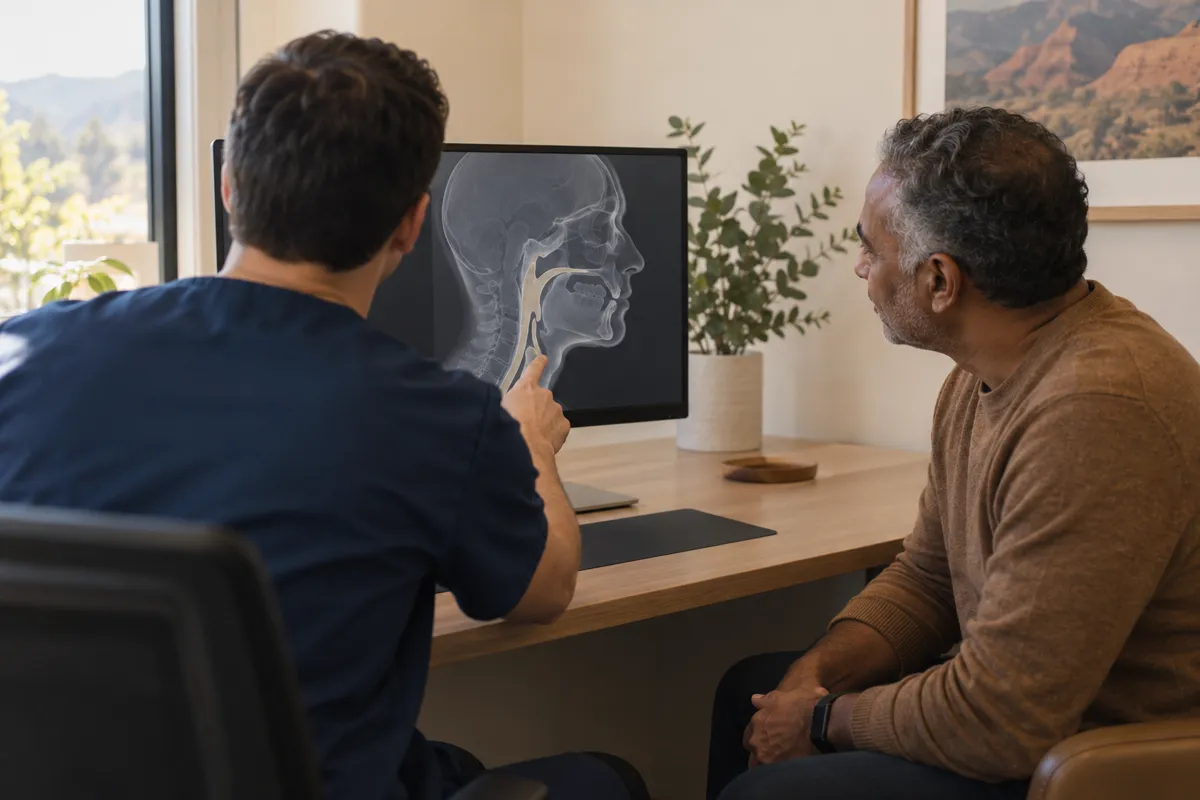
Consult and check
We check your tongue, lips, breathing, and sleep.
 2
Your exercise plan
We explain your plan and costs, and how each exercise works.
 3
Practice and follow-up
You practice at home, and we check your progress.
Incredibly kind, thorough, patient, and knowledgeable drs. Highly recommend
Every person is different. Read patient reviews →
Meet your Colorado Springs airway dentists.
Our doctors bring 25 years of combined experience in airway and sleep care.








Come with questions. Leave with a clearer next step.
A myofunctional therapy consultation starts with what you want to improve. You do not need to choose exercises or diagnose a tongue tie before coming in.
What to bring and discuss
- Your main concern: mouth breathing, tongue posture, swallowing, snoring, or discomfort.
- When it happens, how long you have noticed it, and what you have already tried.
- Relevant sleep-study results, dental records, and current treatment information, if available.
- For a child, observations from caregivers and any existing speech or medical evaluations.
- Your insurance information and questions about costs or scheduling.
Questions to ask before starting
- What did the assessment find, and which goal would therapy address?
- Does anything need medical, dental, or speech-language evaluation first?
- Who would provide therapy, and what training do they have?
- What visits and home practice are involved, and what is included in the estimate?
- How will we measure progress and decide whether to continue or change the plan?
Start at our Colorado Springs office at 2164 Hollow Brook Dr. Review our doctors' training, billing information, or planning a visit from out of town before booking.
What is myofunctional therapy?
Myofunctional therapy, also called orofacial myofunctional therapy, is a set of simple exercises for the tongue, lips, and face. It trains these muscles to rest and move well, so the tongue sits at the roof of the mouth, the lips stay closed, and breathing happens through the nose. It can help kids and adults.
Does myofunctional therapy really work?
It may help, especially as part of a bigger plan for breathing, sleep, or a tongue tie release. Results depend on the person and on daily practice. Every person is different. We'll tell you honestly whether it fits your goals before you start.
Does myofunctional therapy work for adults?
Yes, adults can receive myofunctional therapy for oral resting posture, swallowing patterns, and mouth-breathing habits. Myofunctional therapy for adults starts with a specific functional goal and an assessment of any medical or dental issues that also need care. The right plan depends on what is causing the difficulty and what you want to improve. See ASHA-linked patient guidance on orofacial myofunctional disorders.
Can myofunctional therapy help TMJ symptoms?
Jaw pain needs an assessment before choosing exercises. Some people may need help with oral habits as part of a broader plan, but myofunctional therapy is not a universal treatment for TMJ disorders. The National Institute of Dental and Craniofacial Research recommends starting with conservative care and notes that jaw or facial pain can have other causes. For pain, locking, or limited opening, start with a TMJ evaluation rather than a generic exercise routine.
How is myofunctional therapy different from speech therapy?
Myofunctional therapy focuses on oral muscle function and resting patterns. Speech therapy can address communication needs such as speech sounds and language. These areas can overlap, but tongue exercises do not replace a speech-language assessment. If speech or swallowing is a concern, a speech-language pathologist with relevant training can help determine the right care. Read the patient guide linked by ASHA.
How much does myofunctional therapy cost?
The cost depends on the assessment, recommended visits, and length of your plan. At your consult, ask for an estimate that separates the initial evaluation, therapy visits, and any other recommended care. Ask what follow-up includes and whether a referral would be billed separately. We'll go over the proposed costs before you decide to start.
Does insurance cover myofunctional therapy?
Coverage depends on your policy, the service provided, and the clinician billing it. Bring your insurance card and ask your insurer about benefits, referral requirements, and any visit limits. A benefit check is not a guarantee of payment. Our Insurance & Billing page explains how we help you understand your options.
How long does myofunctional therapy take?
There is no single schedule that fits everyone. Your starting function, goals, ability to practice, and any other care all affect the plan. Before starting, ask how often visits are recommended, how much home practice is expected, and when progress will be reassessed. If an exercise is difficult or uncomfortable, tell your treating clinician so the plan can be adjusted.
Can myofunctional therapy help sleep apnea?
Myofunctional therapy for sleep apnea may be considered alongside other treatment for selected patients. The AADSM evidence review found uncertainty about using it as a primary standalone treatment and insufficient evidence that it prevents or cures sleep apnea. Keep using prescribed CPAP or an oral appliance unless your treating clinician advises a change. Feeling better or snoring less does not by itself confirm that sleep apnea is controlled. Learn about sleep apnea treatment.
Can myofunctional therapy help snoring?
It may. Stronger tongue and throat muscles, plus breathing through the nose, may reduce snoring for some people. If you snore with pauses or gasps, get checked for sleep apnea first. Learn about our snoring treatment options and how we find the cause.
Is myofunctional therapy good for kids?
Myofunctional therapy for kids can address oral movement and resting habits when a child is ready to participate. The plan should fit the child's needs and ability to practice, with caregiver support. Persistent mouth breathing, speech concerns, or snoring may also need medical or speech-language assessment. Our kids' airway care page explains the broader evaluation; exercises alone are not a proven cure for childhood sleep apnea.
Do I need myofunctional therapy before a tongue tie release?
Exercises are often recommended before and after a release. They help prepare the tongue and support healing, so it learns new ways to move. We'll tell you which exercises fit your plan. Learn about tongue tie release, including for adults.
What is tongue thrust?
Tongue thrust is when the tongue pushes forward against or between the teeth when you swallow or speak. It may be linked to mouth breathing. Exercises may help the tongue learn to rest and swallow the right way. Every person is different.
What is Buteyko breathing?
Buteyko is a breathing method that teaches slower, lighter breathing through the nose. It may help with mouth breathing, snoring, and breathing habits linked to poor sleep. Dr. Williams is a Buteyko breathing instructor and can tell you if it fits your plan.
Can I do myofunctional exercises at home?
Home practice is often part of an individualized plan. Myofunctional therapy exercises should be selected and demonstrated for your needs, with a way to check technique and progress. A generic video or exercise PDF cannot assess a blocked nose, restricted movement, or jaw pain. Ask your clinician what to practice, how often, and what to do if it hurts; do not push through pain.
Where can I find myofunctional therapy in Colorado Springs?
Our office is in Colorado Springs, and we welcome patients from Monument & Palmer Lake, Fountain, Falcon & Peyton, Black Forest, Woodland Park, Castle Rock, Pueblo, and Cañon City. Dr. Williams is a Breathe Institute ambassador. We start with a consult and exam, then build a plan that fits you.
How do I choose a qualified myofunctional therapist?
Ask about the clinician's professional license or qualification, specific myofunctional training, and experience with your age group and concern. Also ask who will supervise home practice, how progress will be checked, and when they refer to a dentist, physician, or speech-language pathologist. At your consult, clarify who would provide each part of the recommended care and where appointments would take place. You can review our dentists' backgrounds before your visit.
How will I know whether myofunctional therapy is helping?
Agree on a practical goal before you begin and ask how it will be checked at follow-up. Keep notes about what is easier, what is unchanged, and any difficulty with the exercises. Before-and-after photos alone cannot show whether swallowing, breathing, or sleep has improved. If sleep apnea is part of your diagnosis, your sleep clinician determines whether follow-up testing is needed; symptom changes alone do not establish control.
Can exercises fix mouth breathing if my nose is blocked?
A persistently blocked nose needs assessment. Allergies or enlarged tonsils and adenoids may contribute to mouth breathing, and medical issues may need attention before habit training. Tell your clinician if nasal breathing feels difficult. The patient guide linked by ASHA explains why a dentist, physician, and speech-language pathologist may each have a role.
What the research can & cannot tell us.
Research on myofunctional therapy for sleep apnea is promising in some settings, but results vary. The 2024 AADSM consensus review found mixed evidence and uncertainty about using it alone to manage adult sleep apnea. Evidence for preventing or curing sleep apnea is insufficient. That is why a plan should name the function being treated and explain how other recommended care fits.
Useful progress means a meaningful change for you, supported by the appropriate assessment. A quieter night or a different-looking photo is not enough to prove that sleep apnea has resolved. Ask your clinician what outcome is realistic for your situation.
Professional guidance & further reading
- ASHA-linked patient guide to orofacial myofunctional disorders — symptoms, assessment, and the roles of different professionals.
- NIH/NIDCR: temporomandibular disorders — understanding jaw pain and conservative treatment options.
- Myofunctional therapy for sleep apnea: systematic review (2015) — earlier research, considered alongside the more recent professional review.
- AADSM consensus on emerging sleep apnea and snoring therapies (2024) — evidence and its limits for adults and children.
Start with a tongue and breathing check.
One visit shows if exercises fit your plan.